
Devil as the Dream
Yasmin Zaher’s The Coin reviewedBy Hanif Karim
The Coin
By Yasmin Zaher (Penguin Random House Canada)(2025)
Share Article
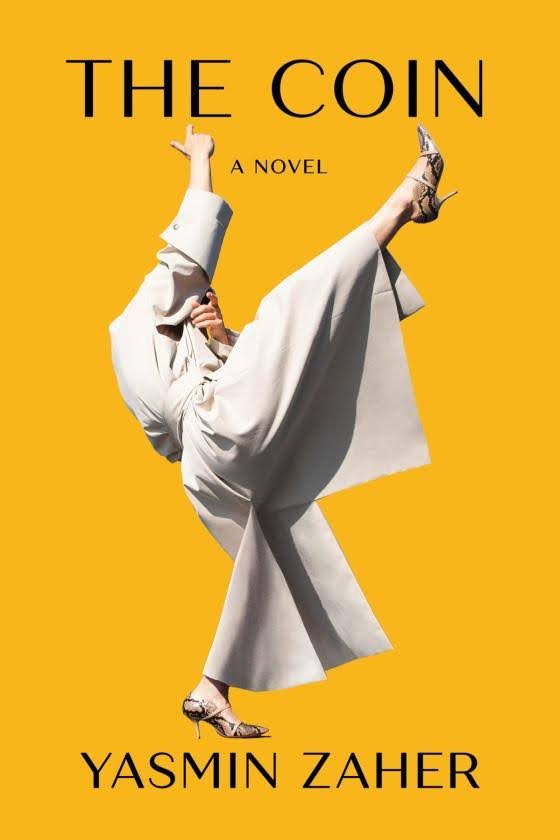
Vines Den Gallery on a late Saturday afternoon in August was the site-specific preface to my reading of The Coin by Yasmin Zaher. For weeks I had been carrying the book around town – in a pocket – or the much-preferred red-leather satchel – a notebook and a pen (at the ready) – Muslimgauze through the headphones. In coffee shops I would place the novel beside me - its distinctive mustard-coloured cover adorned with a dervish-like figure - all trenchcoat and limbs and heels - a compelling invitation - but had never made it past that telling opening sentence: “Dirt was my first hypothesis”.
The rain was falling, hard, slanted, when I entered the unassuming space. Driving in Palestine - photographs by Rehab Nazzal - was being de-installed. The sallow, unvarnished surfaces were overwhelmed with the mute, brutal architecture of occupation – To drive in Palestine is to pass through a landscape cut by walls, watchtowers, gates, and fences—where every turn, every stretch of road, is marked by a regime of control.
Early in the novel, our unnamed narrator recounts a brief story of driving in Palestine. She is a child – it’s a family vacation, an interminable journey south – through the desert. She is in the backseat with her brother - playing with coins – “one shekel and twenty agoras, throwing them in the air and laughing”. Then, with a sleight of hand, she swallows the “cute little silver” shekel. The coin disappearing into her body – traceless. “I was a magician”.
Returning home from their vacation, her father falls asleep at the wheel and both parents are killed – or, more accurately (and laconically), “died”; pitch-perfect passivity. Life happens; we are at its whim. “It was a tragedy, but somehow I got lucky, I was redeemed by a good inheritance. If anyone can understand this, I know it is you”.
You.
The coin lies dormant for years until it is conjured into being – in her Brooklyn apartment - by the vibrating sound of a neighbour’s clarinet. She has been sunning herself in the “perfect square” of light that descends through the living-room skylight at noon – looking at, examining, her “deceiving complexion” – an Arab woman in New York who “blended in wherever I went”: teaching at a middle-school for boys; spritzing Lys Mediterranée – the scent like “an inseminated flower on a summer night in a coastal city…like the opposite of incest”; scrubbing her body with a Turkish hammam loofah, “peeling off the dead skin”. She dresses in McQueen - Miu Miu, a sweater by Cucinelli, a Fendi blouse, a Burberry trenchcoat. She is self-contained. That afternoon, though, she feels it inside of her – the coin – that coin - as she lies prone on the warm, hardwood floor of her apartment – the sunlight shape-shifting - “[a]t first it just wobbled, heating until it got hotter than the rest of me, until it was finally blazing and spinning inside my body…a strange feeling but not unpleasant”.
There is, of course, a certain, how shall I put this, currency to this coinage. The white noise of occupation. The incorporation of the foreign object: an object through which the colonial subject is subjugated. Stateless, currency-less. In thrall. That silver shekel, rusting and metastasizing – “decomposing inside of me…” “I was convinced that it was the cause of everything, that need for a tight grip on the universe, and especially the dirt”. After all, “I came from Palestine, which was neither a country nor the third world, it was its own thing and the women in my family placed a lot of importance on being clean, perhaps because there was little else they could control in their lives”.
The Coin turns on this dialectic - of dirt and cleanliness and the socially necessary labour required to attend to it. The narrative and its politics are minted through this motif – through the body and its myriad functions and demands – unquenchable needs and desires.
“Why is it that the poor are dirty and the rich are clean” - she asks us. But we already know the answer to this – don’t we?
“All I want is to be clean”.
Later, she observes how “[t]he coin had changed my personality entirely. I was impatient, impulsive, harder to please.” Here, in America with its “crackheads in the streets and cokeheads in the high-rises” and what it had done “in Vietnam, in Guatemala, and especially to my people. That makes sense, doesn’t it? I mean, how could the devil be the dream?”
You.
You can read the novel as an experiment in search of an alternate hypothesis; or, let’s say, a how-to-book on shaving and scrubbing until your skin gleams, polished. How to sort your trash and have sex and transcend the present. Or a manual for doing laundry, as when her aesthete, hand-holding, platonic-ess lover, Trenchcoat (so-called because he found and appropriated her beloved Burberry) moves in with her, and agrees to wash and iron her clothes, and you, the reader, follow along (taking notes and) attentive to her meticulous instructions: “begin with the underwear, socks, and undershirts…stop the bathroom sink and fill it with warm water and two squeezes of Genie delicate detergent, stirring with a wooden spoon that I keep here…the laundry is like a cake that bakes”.
The quotidian necessity of reproductive labour – banal, but beautiful.
“All I want is to be clean”.
You might marvel at the work she assigns her students – in the school with the “blue walls, blue stairs, blue doors” – to “write about an encounter with a stranger”, to “clandestinely interview a member of their household, to lead them to some truth they refuse to acknowledge”, that she screens a film about Stokely Carmichael, has Trenchcoat explain the rules of men’s fashion to the shy, eager boys.
You might thrill to the cultural logic of late capitalism, brilliantly observed in the Hermès showrooms of Paris where she and Trenchcoat quest after the postmodern grail itself: a Birkin bag. “In the corner of the store, near the porcelain, I saw one young woman, blond, very slender, carrying a Louis Vuitton mini duffel bag. I felt that she was part of our scheme, that she was my competitor for the day’s last Birkin”. As it turns out, our Palestinian protagonist secures it for herself – a size 35 bag in crocodile skin sold to her by Mubarak, a Malaysian with “taut, maple skin and long lashes…He had just become a French citizen, he said and his friends wanted to go to the Pride parade in Tel Aviv but he was still hesitant”. Such a rich, freighted sentence. It contains everything you need to know about the world - in this moment - and about a novel that gives it to you straight, with a twist.
Near the end of the novel, she travels upstate with Sasha – an on-again-off-again boyfriend - a “one foot on the ground” relationship vessel. Sasha stays indoors – working – cooking – doing dishes - while she walks into the woods “[the] trees were the tallest I had ever seen”. A deer “staring at me…long stretches of undisturbed mountains…It was a kind of nature I was unfamiliar with”.
Instead, “I come from a land that is a graveyard”.
I had never heard of the Birkin bag before reading Zaher’s novel. But it shows up early and it turns heads. It’s “just a bag”, she tells us, “let’s not exaggerate”.
“But sometimes the smallest detail is a portal into another world”.

Hanif Karim never what might have been - always the possibility of the horizon - worthless animal
More
Explore More Rungh