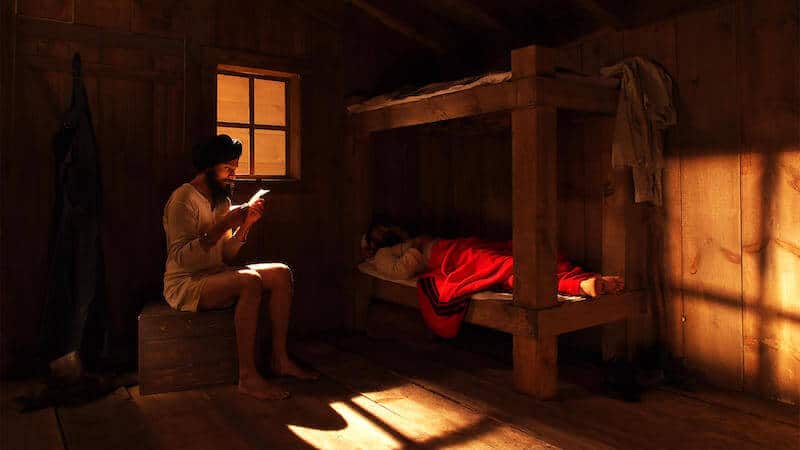

Searching For Serafim
The Life and Legacy of Serafim “Joe” Fortesby Ruby Smith Díaz

Excerpt from Searching for Serafim: The Life and Legacy of Serafim “Joe” Fortes (2024)
by Ruby Smith Díaz
Share Article
Chapter 1: Querencia
Like Serafim Fortes, I am from sugar cane, from cacao, from árboles de café. I am from cilantro and mananitas on your birthday, and té de menta when your stomach is sick. When I tell his story, I cannot skim over the history that made him who he was and shaped the way he thought. For many who have not had to prove their existence in a white dominant society, these details are often meaningless; they have been left out of articles and books written about Serafim’s life. These are not meaningless for me, nor for millions like me. On the contrary, these details are the pillars of his story as a man of mixed ancestry from Trinidad. In telling his story, I reveal a part of my own.
Many a night I have caught my mind wandering through the towering skyscrapers and wet pavement of Vancouver streets, the same streets that Serafim may have wandered over a hundred years ago. Under the glow of the same moon, I lengthen my stride, catching up with the first steps my mother took under moonlight on Turtle Island, free of the toque de queda (curfew) that she left behind in Chile. Just like her, I walk the streets at midnight for no reason other than to feel the light of freedom on my cheek. With my callused fingers, I trace the knotted cedar tree roots exposed through concrete, admiring their refusal to be forgotten. As I honour the cedar roots, I call to mind my father’s lineage, who survived their kidnapping from the African continent to Caribbean shores and never forgot their songs or traditions. Somewhere in my body’s story lives the DNA of someone in my family who survived that journey and made it to Jamaica, held hostage in the name of profit. Somewhere on another slave ship, on another shore, the ancestors of Serafim arrived, also held hostage. My mind wanders often, getting entangled in time, imagining what it would be like to wander the streets in shoes like mine, in a different time.
A different time, like in 1498, when a lost Italian navigator by the name of Cristoforo Colombo came across the island of Kairi in the Caribbean Sea, just north of modern-day Venezuela. Lush tropical vegetation and an abundance of wildlife surrounded its three mountain ranges, creating a beautiful homeland for the Taíno and Kalinago peoples. There was melodic uproar in the trees, marking the presence of bountiful avian diversity; ocean waves washed over rock, keeping time with the moon. These bountiful homelands would never be the same after Colombo’s accidental arrival.
Enacting the Doctrine of Discovery through the Papal Bull of 1493, Colombo stole the lands of Kairi in the name of the King of Spain and renamed it La Trinidad, effectively dispossessing thousands of inhabitants on the island and enslaving these nations for the profit of European Christian kings. The first enslaved Africans were brought to Kairi’s shores in 1606, and Spain continued to amass riches through the theft of natural resources and the forced labour and torture of enslaved African peoples. This violent cycle would continue into the 1800s, even after the Spanish were surrounded by British warships and forced to cede the stolen lands. It did not matter to either power that human beings were trafficked, tortured, and killed. What mattered was who had control of the land and who could amass wealth the quickest.
[Daylight come and me wan go home1]
Somewhere in this truth lies the tragic irony of being ripped away from your own lush homelands an ocean away, surviving months and months in the belly of a ship—lying in your own feces, mourning your dead while chained to their bodies, wishing for death or for this misery to somehow end—only to arrive in another lush tropical paradise to be sold, enslaved, and have this same cursed story repeat for generation upon generation, for over three hundred years. Somewhere among these truths is the tragic irony of calling the lush tropical paradise that you and your ancestors were enslaved to “home.”
[Daylight come and me wan go home]
This story unfolded violently again and again throughout the Caribbean, North America, and South America and facilitated the creation of most modern states, with stolen lands and the enslavement of Indigenous and African peoples as their economic foundation. Only in 2023 was the Doctrine of Discovery rescinded by the Vatican, following another wave of protest by Indigenous communities during the Pope’s visit to Canada. Ground-penetrating radar has now confirmed what Indigenous communities in Canada have always known about: the presence of thousands of children’s bodies at residential schools run by the Roman Catholic Church. These children were ripped away from their families and brought to residential schools across Canada, starting as early as the 1600s and continuing into the 1990s. At the time of this writing, it is confirmed that at least 4,100 children died as a result of illness, neglect, abuse, or suicide connected to residential schools, but more bodies continue to be uncovered, and many more will never be accounted for due to “lost” documents, poor record keeping, and the withholding of documents by the Roman Catholic Church.2
[Daylight come and me wan go home]
Serafim Joseph Fortes was born amid these parallel stories of dispossession and enslavement on the beautiful island of Kairi around 1865.3 At birth, he was anointed by the rivers and swamps of the island and grew up embraced by the coral reef that crowns its majestic shore. He was born free, a mere thirty years after slavery was abolished across the so-called British Empire.
Just like my father, Serafim’s father was descended from enslaved kin. He was likely born on the cusp of abolition in the British colonies around 1834, meaning that the difference of only a few years spared him the fate of becoming the property of a human trafficker for his lifetime. Archival records from Kairi simply cite his occupation as “farmer.” Given the continued British colonial rule over the island after 1834, there likely were few to little economic opportunities for Serafim’s father besides working on a sugar cane, coffee, or cacao plantation, the primary export industries at the time.
Serafim’s mother, just like my mother, was a Latina. There is much speculation as to whether his mother was of Spanish or Portuguese descent. Because Serafim is listed in the Vancouver Census as speaking both Spanish and English, and because his surviving pieces of writing are in a mix of Spanish and English, I feel it is safe to assume that Serafim’s mother was not of Portuguese origin. However, just as likely as his mother being of Spanish origin is the strong possibility that she was from Venezuela, given its eleven-kilometre distance from the coast of Trinidad and the history of migration between the two land masses.
As an Afro Latino, Serafim likely grew up hearing Spanish, English, and Patois in his home and community. One of two surviving documents of his writing, on yellowed and tattered paper, filed away at the Vancouver Archives shows his cursive in a mix of both Spanish and English, with neither language written very proficiently. Perhaps Serafim learned to write cursive as a child, practising from the Silabario grammar book just like I did, occasionally interjecting diptóngos in English and Patois.
In one of my imaginings, the edges of his schoolbooks catch dominoes slamming on kitchen tables and interrupting painstakingly shaped cursive, while the ruled lines are infused with roti, cilantro, and discipline. In another imagining, Serafim’s father, exhausted after a back-breaking day on the sugar cane plantation, sings a kaiso tune to his son as he sits on the porch underneath a kapok tree, cussing out a master who forced his people to labour to death, belting out the spirit of rebellion in a premonition of the Canboulay riots.
Footnote
[1]
“The Banana Boat Song,” a traditional Jamaican folk song made famous by Harry Belafonte’s 1956 version.
[2]
vanbuekl, “Concerted National Action Overdue for All the Children Who Never Came Home from Residential Schools,” National Centre for Truth and Reconciliation, June 2, 2021, https://nctr.ca/research/concerted-national-action-overdue-for-all-the-children-who-never-came-home-from-residential-schools/.
[3]
Serafim’s exact birth year is unclear; some sources point to 1865 and others to 1863. This uncertainty opens to the door to what MarieClaire Graham calls “speculative archiving,” a speculative methodological approach to restoring
silenced Black voices in the official record. (MarieClaire Graham, “Imagining the Archive: Speculation as a Tool of Archival Reconstruction” [MA thesis, City University of New York, 2019], https://academicworks.cuny.edu/gc_etds/3189/.)

Ruby Smith Diaz is an Afro Latina multidisciplinary artist, educator, and award-winning body-positive personal trainer.
More
Explore More Rungh