
Let’s Look Again
Canadian Arts in PhiladelphiaBy Madeleine Reddon

Brian Jungen and Duane Linklater
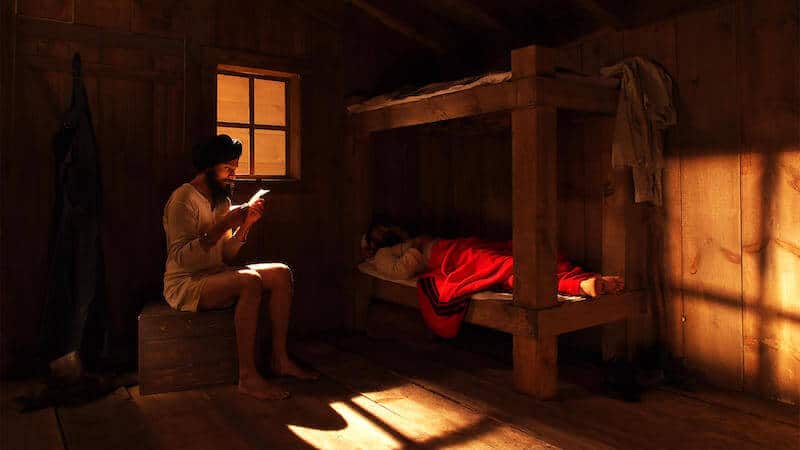
Modest Livelihood (still), 2012
Super 16mm film transferred to Blu-ray 50 minutes (silent)
Courtesy of Catriona Jeffries, Vancouver
Share Article
Where I Learned to Look: Art from the Yard Institute of Contemporary Art University of Pennsylvania, Philadelphia, PA July 13 – December 1, 2024
Arriving at the Institute for Contemporary Art in Philadelphia this past July for Where I Learned to Look: Art from the Yard, I’m greeted by an exceptionally friendly sign of home. Feeling a little defeated by the “east-coast-ness” of it all in Philadelphia, I’m delighted to see Vancouverite Ken Lum’s You Can’t See Me! (2023) prominently featured in the gallery lobby. I love Lum’s photo-text series very dearly and every time I encounter one out in the wild it’s like getting a little treat. This artwork isn’t part of the show I’m seeing but it seems to resonate with some of its central conceits. In this image, a cute Asian kid plays hide and seek in a sculpture garden. Hidden in plain sight, the child looks off to the left presumably at one of their parents just out of frame. In the background, there is a classically rendered stone sculpture of a sitting man, facing away from the camera, and a frieze carved into the stone wall encircling what Lum identifies in paratextual notes as the courtyard of l’École des Beaux Arts in France. While the statue seems crumpled, turned inwards and away, the child seems joyful, sparkly and full of life. Where I Learned to Look: Art from the Yard begins with a curatorial statement from guest curator Josh T. Franco on the art of looking:
When my grandfather, a prolific yard artist, passed away, I photographed his yard as an act of mourning. My brothers, cousins, and I spent hours interpreting, inventing, and collaborating in his elaborate, hand-built environments. These were the unexpected training grounds for my earliest exercises in close observation, a skill central to my work as an art historian. My grandfather’s yard is where I learned to look.

Brian Jungen and Duane Linklater
Modest Livelihood (still), 2012
super 16mm film, transferred to Blu-ray 50 minutes, silent
Courtesy Catriona Jeffries, Vancouver
The show celebrates the yard as a curated space of play where children develop their earliest kinds of attention and focus. Its liminality as a public and a familial space is part of what allows the yard to catalyze imagination. Like the gallery space, the yard becomes a place where objects are placed to draw our attention, arrest a movement, or create moments of surprise and pleasure. Learning how to look helps defends against the overwhelmingly enigmatic dimensions of adult life. Franco’s memorial to his grandfather is one example of how this early training anticipates representation and might ground our ability to celebrate and remember others for their uniqueness. Like Franco, the refrain of Lum’s child—"You can’t see me! / I’m over here! / Here! / Over here!”—invites us to take pleasure in finding something hidden in plain sight, much like Franco’s child who finds worlds within worlds in the yard.

Installation image
Where I Learned to Look: Art from the Yard, 2024
Image credit: Constance Mensh


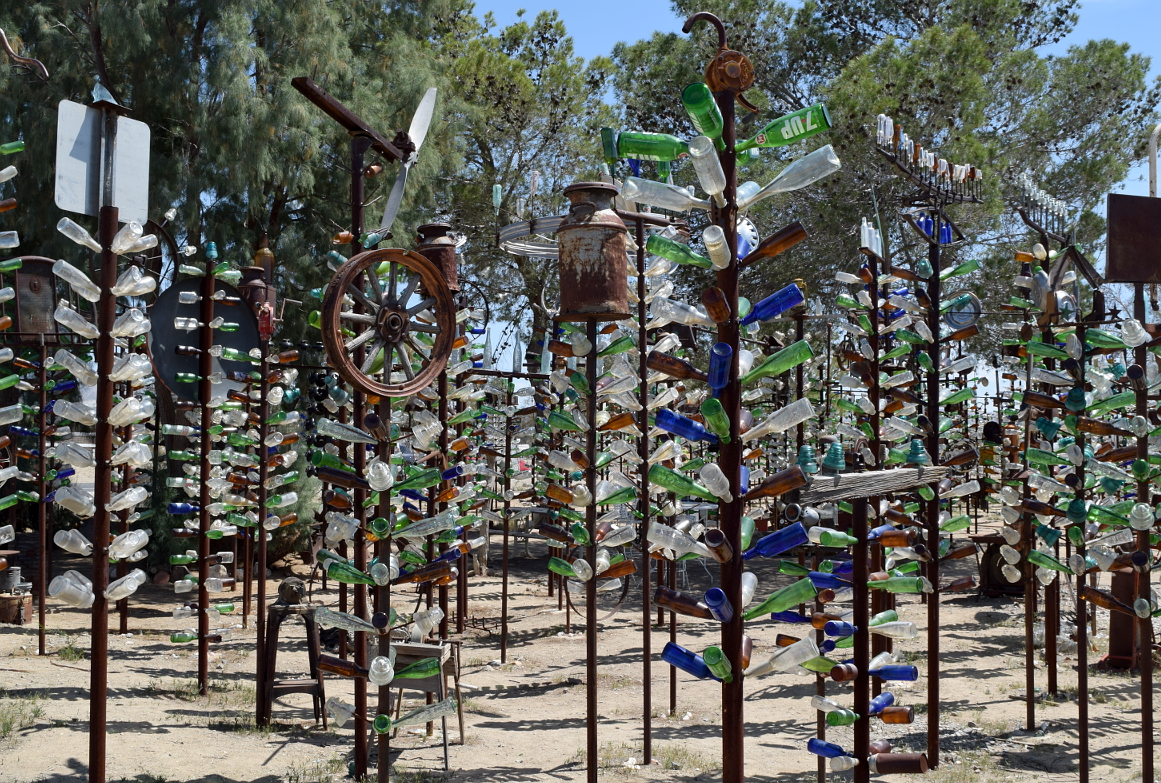
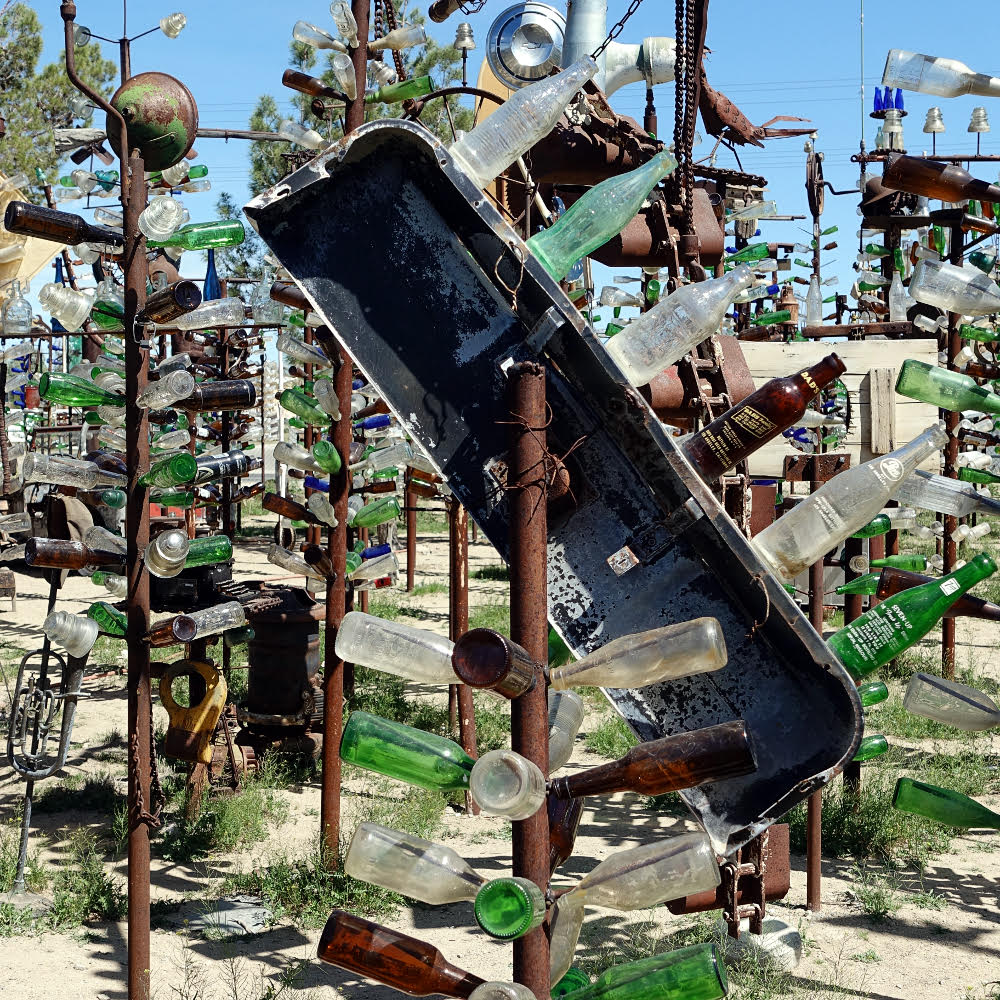
The exhibit interprets “the yard” broadly to mean “a patch of grass, a strip of sidewalk, a fencepost, the open woods, or even a notebook.” There are thirty-three artists from across North America represented in the show and over thirty separate works. Some works in the show are devotional pieces. Sitting in the corner of the room is vanessa german’s nothing can separate you from the language you cry in (2019), a huge sculpture comprised of three human-like figures with skirts made of blue and clear glass bottles and inscrutable faces made of ornate blue glass birds, flowers, mirrors, and gold brass fixtures. Reminiscent of the dress shapes of Rebecca Belmore’s Rising to the Occasion (1987), these figures read as imposing odes to bottle trees and their ability to capture sun (or spirits) within them. (Looking at them, I couldn’t help but think about the bottle tree forest fondly described to me many times by Vancouver photographer and bookseller, Chris Brayshaw, who, arrested by their glowing, electric beauty, felt compelled to return again and again to photograph them in the Mojave desert near Barstow.) Other memorable gems were Wendy Red Star’s rez car photographs, a hilarious video of a dancing lawn mower intercut with blooming flowers by Rubén Ortiz Torres, and a modest snake sculpture made from painted garden rocks by the Bridge Way School Recovery Artist-in-Residence program. As one of Rungh’s “foreign” correspondents below the medicine line, my review focuses primarily on the Canadian artists represented in the show apart from the curator’s work.

José Esquivel
Nuestra Señora, 1995
Acrylic on Canvas
16 x 20 inches
Photo by Mario Esquivel


When attendees enter the exhibit, they are greeted by a film that is projected on the wall to the right. In front of the projection, a semi-circle of tires surrounds a small yard of landscaping rocks dotted with unlit candles and empty jars. At the far back, nearest to the wall on the left, is a small roadrunner sculpture set atop a Texas shaped garden stone painted with the state’s flag. The roadrunner is positioned so that it is partially lit up by the light of the screen. The rippling light of the projection makes the roadrunner look animated or, occasionally, headless. Franco’s Preparing La Virgen (December 3, 2023, Marfa, TX), 2023-24 is a silent video of a family (a young boy, his grandmother, and his mother or auntie) making a shrine to the Virgin Mary, Our Lady of Guadalupe. The camera is held loosely so that the frame shakes a little like a home video. Viewers watch as the women string lights to attach to a metal star or bend to arrange fake flowers in pots, ending with the shrine’s completion and the family’s departure. The text that appears in the film is written from the perspective of the Virgin who speaks (silently) to the viewer about her relationship to her worshippers and her placement in the garden with one of the most evocative lines describing her light-drenched face feeling hot from the sun. If statues have spirits, as Franco’s piece suggests, what do they think about us? Earlier that morning, I had been at the Washington monument, which is just below the Philadelphia Art museum. Below the watchful gaze of America’s former president, who the Haudenosaunee aptly called Hanadagá•yas (the town destroyer), two “Indians” lounge between a bison and an elk, a flagrant and garish memorial of the American genocide of Indigenous peoples. Pressing my hands to the bison’s face, blisteringly hot in the sun, I thought resentfully about how the city seemed soaked with blood. In hindsight, I wonder whether these statues were talking to me. What might they say? Do they like to be touched? Do they want to be free?
Two other videos in the show about hunting and trapping drew the most attention from me.” The first, Modest Livelihood (2012), is a collaboration between Brian Jungen and Duane Linklater shot on Treaty 8 territory, which films a hunting camp from autumn to winter. The video follows DaneZaa Elder Jack Askoty, Jungen, and Linklater as they walk the land, make camp, and hunt. My favorite parts of the film involve shots of the land in fall: close-ups of the drying grass, its gentle yellows and glimmering light, intercut with close-ups of the hunters’ faces and the backs of their heads as they walk through the woods and cross rolling foothills in search of game. (Readers might have seen a still of this film on the cover for Layli Long Soldier’s poetry collection whereas.) The title, made in reference to the 1999 R v. Marshall decision to limit treaty rights to “the basic necessities of life” (ICA), provides context for understanding the political dimension of land stewardship as an act of sovereignty, which the Crown seeks to curtail and deny. This is a particularly interesting watch, after the 2021 supreme court decision, Yahey v. BC, which ruled that “the Province has failed in its obligation to diligently and honourably implement the Treaty.” In her ground-breaking decision—the first in Canada’s history to admit that a Treaty has been effectively “broken” by Crown representatives—Justice Burke describes the cumulative impact of unfettered development on Treaty 8 lands as a “death by a thousand cuts.” In Modest Livelihood, the hunters access different points of the woods through former logging roads that appear like cuts to “scar the woodlands” (ICA). The film culminates with the butchering of a moose, slicing and pulling the skin away from the bones to make it easier to move in pieces. The cuts are precise and efficient. No waste will be left. Unlike the deathliness that state development seems to spread, the hunters take a life to sustain themselves and their communities without harming the surrounding lands.
The second film, Coney Island Baby (2017), was created by members of the BUSH gallery (Jeneen Frej Njootli, Gabrielle L’Hirondelle Hill, Tania Willard) on Secwépemc land. Referencing Lou Reed’s most romantic album, the title plays on the other meaning of “coney” as a small rabbit. Featuring cinematography by Amy Kazymerchyk and Aaron Leon and scoring by Chandra Melting Tallow, Coney Island Baby begins with an image of the iconic Looney Tunes title credits with red and pink concentric color rings. Instead of Bugs Bunny, viewers see branches illuminated by flashlight in the center of the circles. A hand affixes a tiny wire snare along the tree line. The camera pulls back to reveal a woman setting traps. These concentric cartoon circles reappear between scenes: a couple of women set traps in the forest; a rabbit is being cooked for dinner on a stove top; a young boy pretends to be a bunny hopping around on a kitchen floor; and, outside in the snowy grounds of camp, several of the artists stand around talking to one another as one hangs and skins their catch. The recurring image of the Looney Tunes background and the opera music from the Barber of Seville (a reference to the 1950 episode Rabbit of Seville) creates an interesting parallel between cartooning and trapping as mediating forms. Indian stereotypes are like aesthetic traps. Wading through colonial modernity’s dense bush, sometimes we get caught up in them as colonialism tries to render us in simplified terms. The mass consumption of these images has and continues to have deadly effects on our communities. In comparison, trapping is another kind of capture that uses death to fuel life. Coney Island Baby invites us to think about the generative forms of mediation that come from land-based practices. Whose lives do we catch and capture in the images we make and to what end? How do we use art to extend and foster life rather than crush it? Where I Learned to Look: Art from the Yard suggests we start by training ourselves to look and to look again through the natural and public spaces that teach us how to be with others.
Madeleine Reddon is an assistant professor at Loyola University of Chicago.
More
Explore More Rungh